
No blog post last week, but I promise not to lapse back into my non-communicative ways. In fact, I was exploring Belgrade on your behalf.
I spent the evening at the opera.
It was a spur of the moment decision. I was passing the National Theater when blood red banners with ‘Turandot’ blazoned in Cyrillic letters caught my eye. So I bought one ticket to the premiere for the princely sum of $17.
I only bought one ticket because I thought Ken would be traveling. Or maybe I bought one ticket because I wasn’t sure he would be an enthusiastic opera-goer. Or a receptive opera-goer. Or that I would be a receptive opera-goer. And I didn’t want to have to be an opera ambassador when I’m really just an opera novitiate.
I’ve only been to one other live opera performance. That was 15 years ago, to see Carmen at the Santa Fe Opera, an open-air shell with a southwestern-chic vibe — The Eagles meet Aïda. Dinner receptions, gourmet tailgating picnics, and pre-performance lectures lead up to the event. As the sun sets behind the stage, people make their way to one of a thousand seats and the orchestra cues the opening music, just as the sun nestles below the horizon. A great performance before a singer ever sets foot on stage.
The only other operas I’ve seen were Met Live productions when the opera is simulcast to movie theaters around the globe. These are relaxed affairs with popcorn and bathroom breaks. You are close to the action, but there is such a thing as too close. Have you ever noticed the lip contortions, flared nostrils, and sweaty brows that accompany performances, or the ill effect that vibrato-heavy arias have on otherwise attractive people? I think opera, like polar bears, is best viewed from a safe distance.
All that to say, I was more comfortable going to the opera by myself.
The National Theater is Belgrade’s home for opera, ballet and dramatic performances. The Turks removed from Belgrade in 1867; theater construction began in 1868. As a grand gesture of ingratitude, the Serbians demolished the outermost Turkish gate in the city and used its stones as the foundation for their new European-styled cultural center.

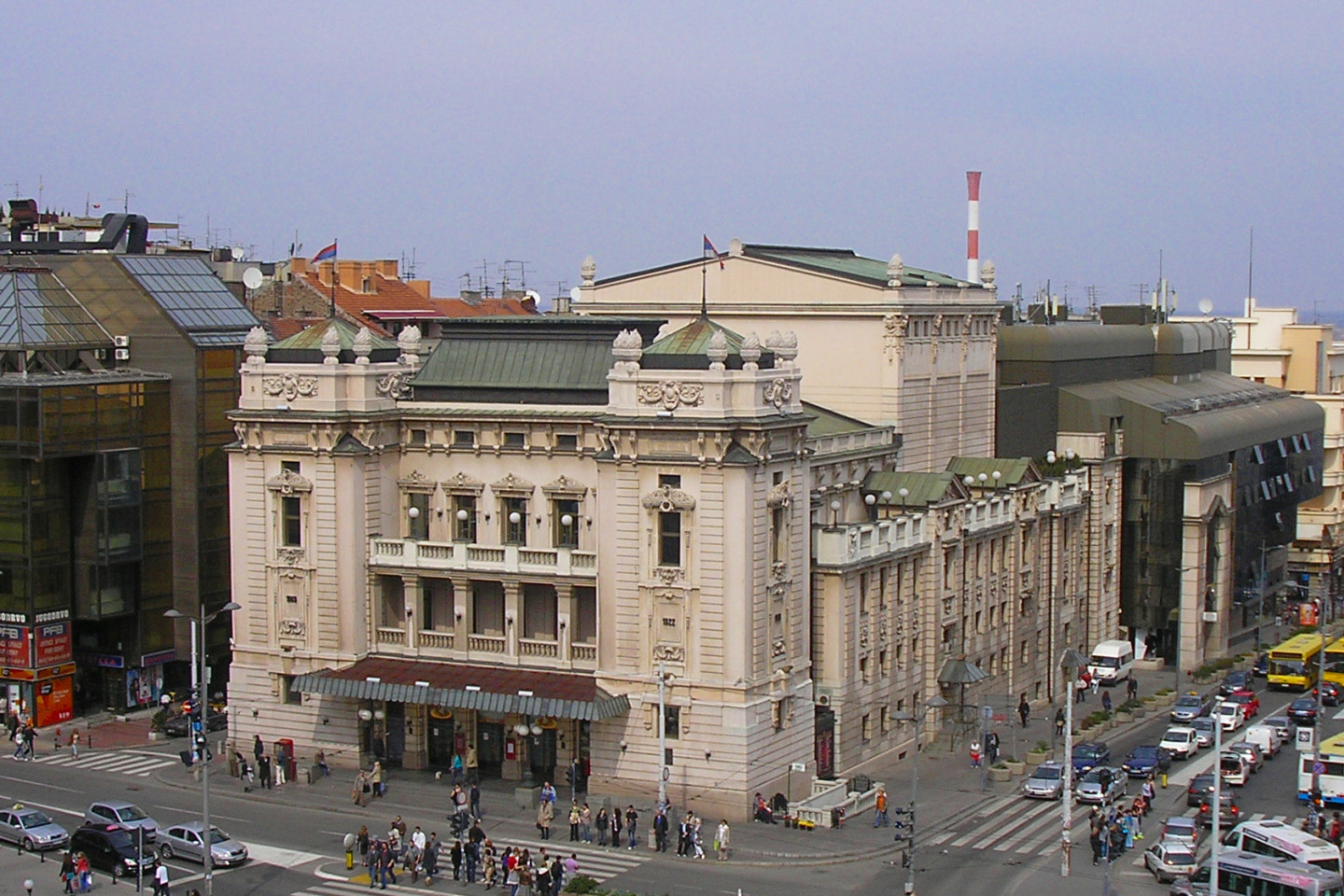
The building was modeled after La Scala in Milan, Italy, but has undergone multiple renovations and refurbishments. Interrupted by the Balkan Wars in 1912, and closed between 1914-1918, performances hiccuped again during the German occupation of 1941-1944 (and one assumes also during the 1990s). Over time, the theater has been enlarged, remodeled, stripped of exterior adornment, accessible only via side doors, bombed, repaired, and finally restored to its golden age glamor.

Initially, it hosted only dramatic plays. Music was limited to short operettas because the budgets and regional talent couldn’t support more. But the influx of Russian refugees after the October 1918 Revolution brought a wave of professionally trained actors, singers, directors, stage and costume designers, and dancers to the city. Beogradjans seem to have responded with long-lasting enthusiasm to the arts — and the social scene — if the event I attended was any indication.
The performance was sold out. Young men and women, in singles, couples, and groups arrived, dressed simply or glamorously. Older men and women clad in 1960s style overcoats and sensible winter shoes carefully tended their paper tickets and made their way through the beautiful gilt foyer.
I was ushered into my seat and immediately passed by a thin blonde woman in over-the-knee stiletto boots, fishnet stockings, a leather mini-skirt, and an opulent vest covered in jet-black passementerie. She sized me up (knee-length wool skirt, fuzzy cream cardigan, plain black boots), wrote me off, then dabbed at her thick black eyeliner with a fingerless lace glove, a la Madonna, 1984. She didn’t intimidate me too much, because I know 75-year old women are really softies at heart.
The three women in front of me seemed like grandes dames on the opera scene. They greeted each other with ahs and kisses, gossiped and passed around throat lozenges, and waved at acquaintances around the theater. Between each act, they were out of their seats, visiting friends in neighboring boxes, or welcoming any number of kith and kin into ours.
On the other side of a balcony pillar, a small, cheerful woman sat down and opened a large box of chocolates. She selected one for the opening scene. I’d forgotten about opera chocolates, but I’m glad that such a classy gesture hasn’t died out.
In a sea of dark-haired people, a shockingly white-blond fellow stood out — Peter Wimsey personified. He leaned his forearms across the balcony railing and waited aloofly for the real performance to begin.
The conductor mounted the podium, five sinister notes sounded, and we were off! Calaf was smitten at the first bloody whack of the executioner’s axe, Liu remained loyal to the bitter end, and icy Turandot melted with true love’s kiss. I followed the storyline despite not understanding the Italian libretto or the Serbian subtitling. And my seat was near enough to enjoy facial expressions, yet far enough to obscure any grimacing contortions.
I think I’ll be back, with my own box of chocolates. (And maybe Ken.)

 There, and Pack Again
Beautiful! I have 17.00, so book it, Danno, and I’ll even spring for the box of chocolates and a few friend’s tickets!
LikeLike
But the opera season ends in March, so we’ll be sitting in an empty theater.
LikeLike